How does Zomato make it’s money?

Ever had a late night craving for some food that soothes your soul and that rumbling belly but to your despair you find nothing in your fridge? Oh, don’t you worry child! You know there is a magical app on your phone that’s going to cater to your cravings with minimal effort from your end.
While these companies have helped us in almost all possible food related situations, have you ever wondered how do they make money? Well, I have and let me help you understand how food-tech companies make money in India.
But, before we dive into how they make money, it is important to understand the context behind how these organisations got here.
History 101 : Food Tech in India With a Dash of Global Tadka
Rolling the clock back to 2012; food delivery as a concept in India has been existing for maybe a decade or two, but at this point in time you would have to place your order offline through your phone at the specific restaurant. Can you imagine doing that today? Probably not, all thanks to the hyper growth of food-tech. Lets take a look at how things have evolved in the space of the same.
India’s food-tech space in 2022 is way different than what it was in 2012, which was the start of the app-led food delivery in India. We had Foodpanda, which started the food delivery business followed by Tiny Owl, Swiggy, Zomato and Uber Eats.
Foodpanda was probably ahead of its time in India and failed to sustain when competition arrived from other new entrants, along with other internal issues. The steep rise of Swiggy and Zomato ensured all other players either consolidated or shut shop. This, for now, has created a duopoly in the Indian food-tech market.
Here is a quick summary on the history and where we stand today:
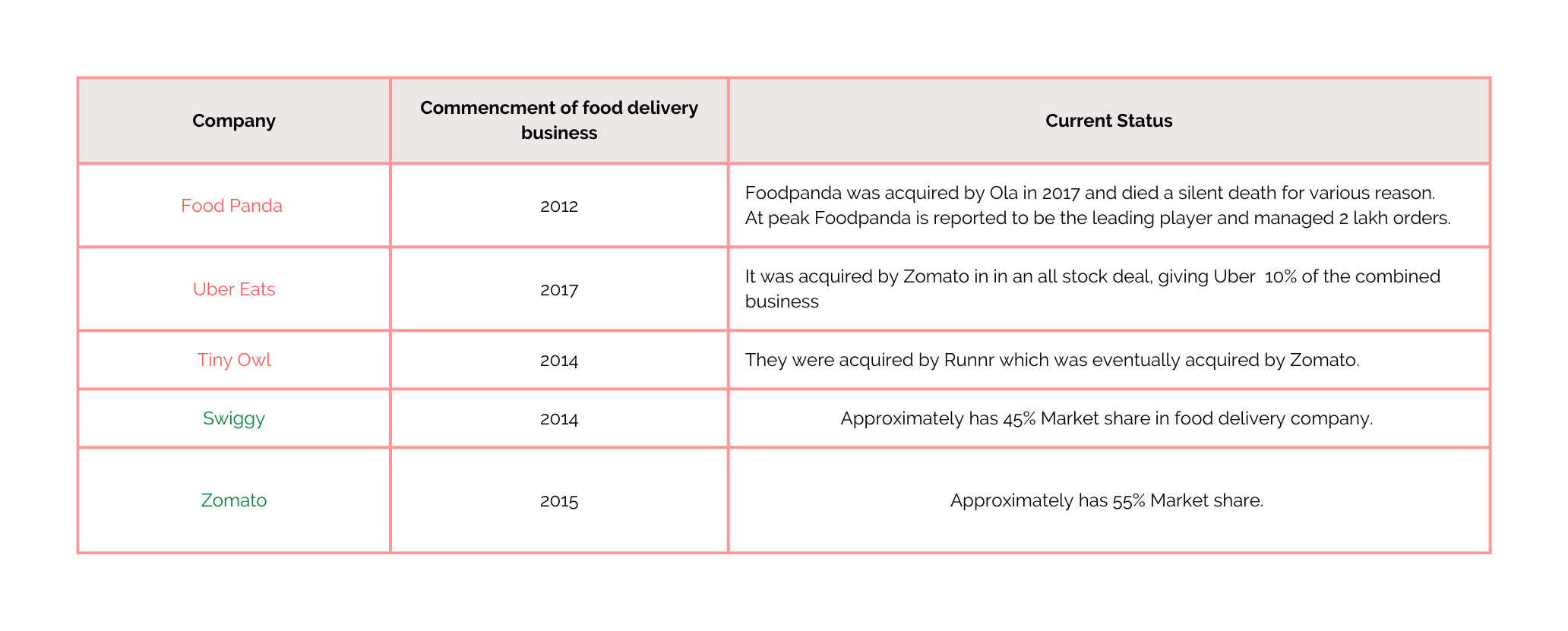
Now that we an idea of how these companies got here, lets dive deeper into the promise I made earlier and understand how Zomato really makes its money.
Zomato currently has 3 major sources of revenue from the businesses they operate:
Food Delivery: User places an order from the app and the orders gets fullfiled by the delivery partner. Here, Zomato makes roughly about 20-25% margins.
Hyperpure: B2B supplies, selling food ingredients directly to restaurants through their supply chain. Zomato makes between 5-15% margin through this.
Dining & Subscription: Restaurant reservations and Zomato Pro subscriptions. Roughly 10-15% margins gets earned.
Currently, food delivery dominates the revenue contribution in Zomato’s balance sheet, followed by Hyperpure, and dining.
Here, the donut represents the exact split for FY21 and FY22.
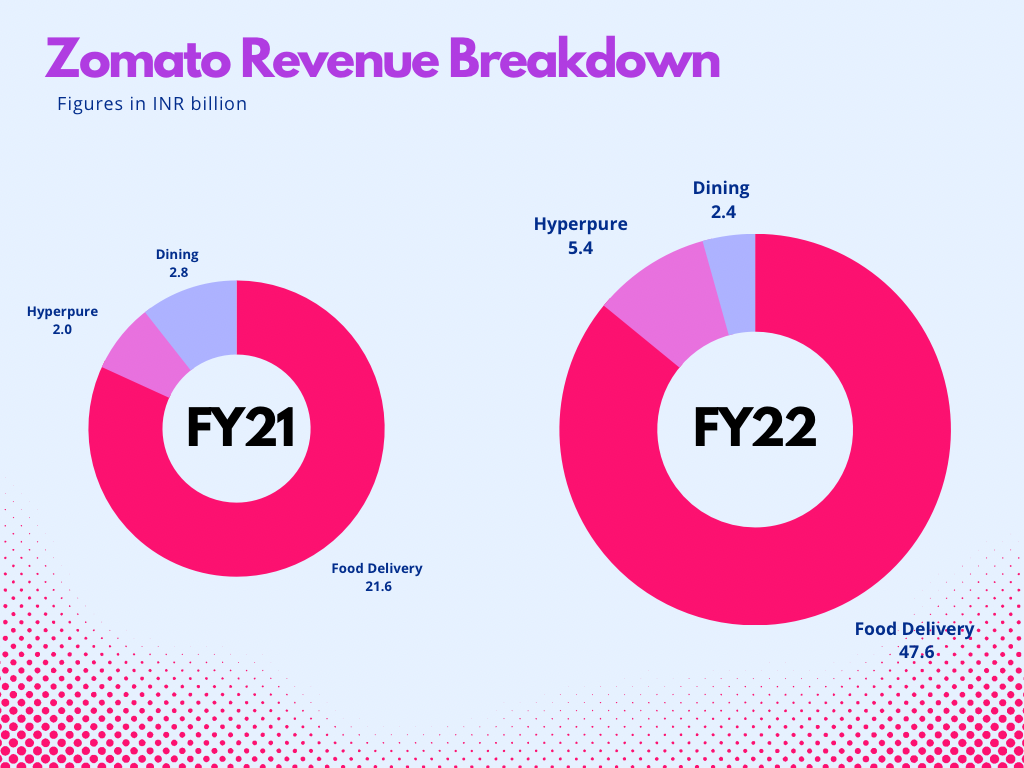
Zomato made INR 55.4 Billion in FY22, which was a growth of 109% over FY21 revenue of 26.5 billion.
Revenue mix has changed slightly with food delivery growing from 81.8% to 85.9%, followed by growth in Hyperpure revenue market share from 7.6% to 9.7%, and degrowth in dining business market share from 10.6% to 4.3%.
However, the silver lining is that the overall revenue of the business grew 109%.
And that’s basically how Zomato makes money today. But as business enthusiasts, we need to ask ourselves how does the future look like for Zomato; and if they will ever turn profitable.
From the recent developments, we know that Zomato has invested in Blink It (Grocery delivery is now live on Zomato’s app which is powered by Blink It’s operation). With introduction of another vertical of business, the board of Zomato has decided to take the google route😛.
They plan to rename Zomato to ‘Eternal’, which will continue to be headed by the current CEO & founder Deepinder Goyal, whereas the other 3 verticals- Food Delivery, Blink It and Hyperpure will be managed by individual CEO’s, who will report to Goyal.
While Zomato has kind of had an experimenting past along with their fair share of success and failures, they now seem to have clarity of where they want to head.
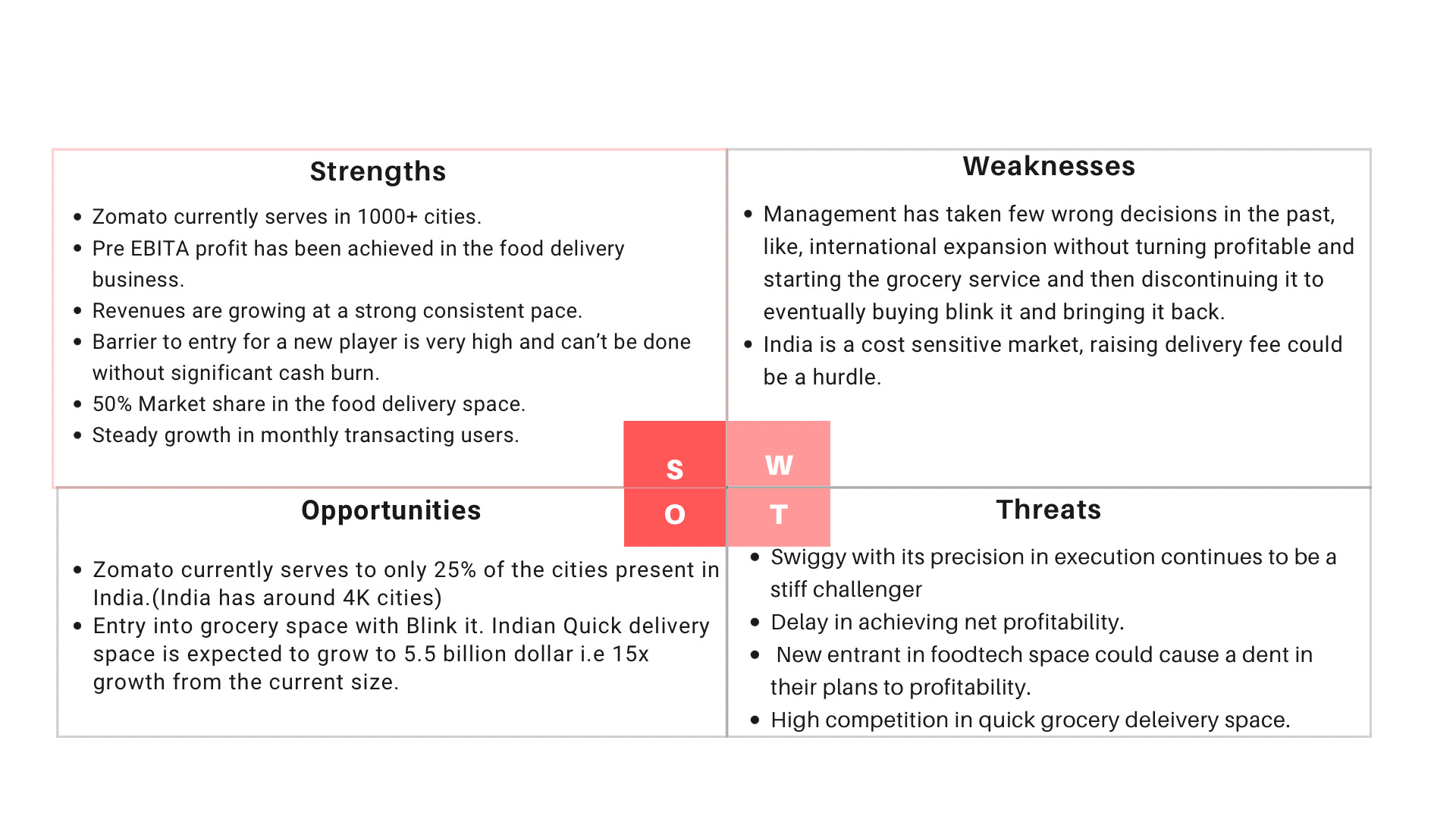
To summarise, I think a SWOT analysis will give us a good idea of where Zomato stands today and what the future holds for them:
Current Revenue and Estimated Future Projection:
Zomato has reported a revenue of INR 14.7 Million in the first quarter of FY23, excluding Blink It revenues. Considering the current pace of revenues, I believe Zomato will close FY23 somewhere around INR 70 million, which is a 27% growth over last year’s revenue. Another highlight from the quarterly results was Zomato achieving operational Pre-EBITA (Earnings Before Interest, Taxes and Amortisation) profits in the food delivery space. This is promising and we could see this venture turning profitable in next 12 months.
Blink It revenues will start reflecting from the next quarter, and they are expected to contribute 20-25% of the revenue for Zomato going forward.
I hope this article was successful in helping you understand the business model of Zomato and how they go about making their money.
Disclaimer: The views stated here are personal and not intended to promote a buy or sell view on Zomato.
Sources used for the article:
deliveryhttps://inc42.com/features/from-foodiebay-to-zomato-the-12-year-journey-that-changed-how-india-consumes-food/
https://b.zmtcdn.com/data/file_assets/4036eaf1e9a73f4d92c56dec1126c36b1659356685.pdf